We’re at AAHKS·Booth 608

How it works
An intelligent surgical system should take on more work while surgeons retain judgment and control and connect what has been separate — bringing planning, execution and recovery together in one continuous care loop.

Know where you’re going before you begin.
Today
Planning built around the surgeon’s preferences
The gap
Plans aren’t informed by how patients recover or predicted functional outcomes
The opportunity
Autonomously analyze patient-specific data, simulate surgical options and recommend personalized plans aligned with the surgeon’s goals and patient expectations
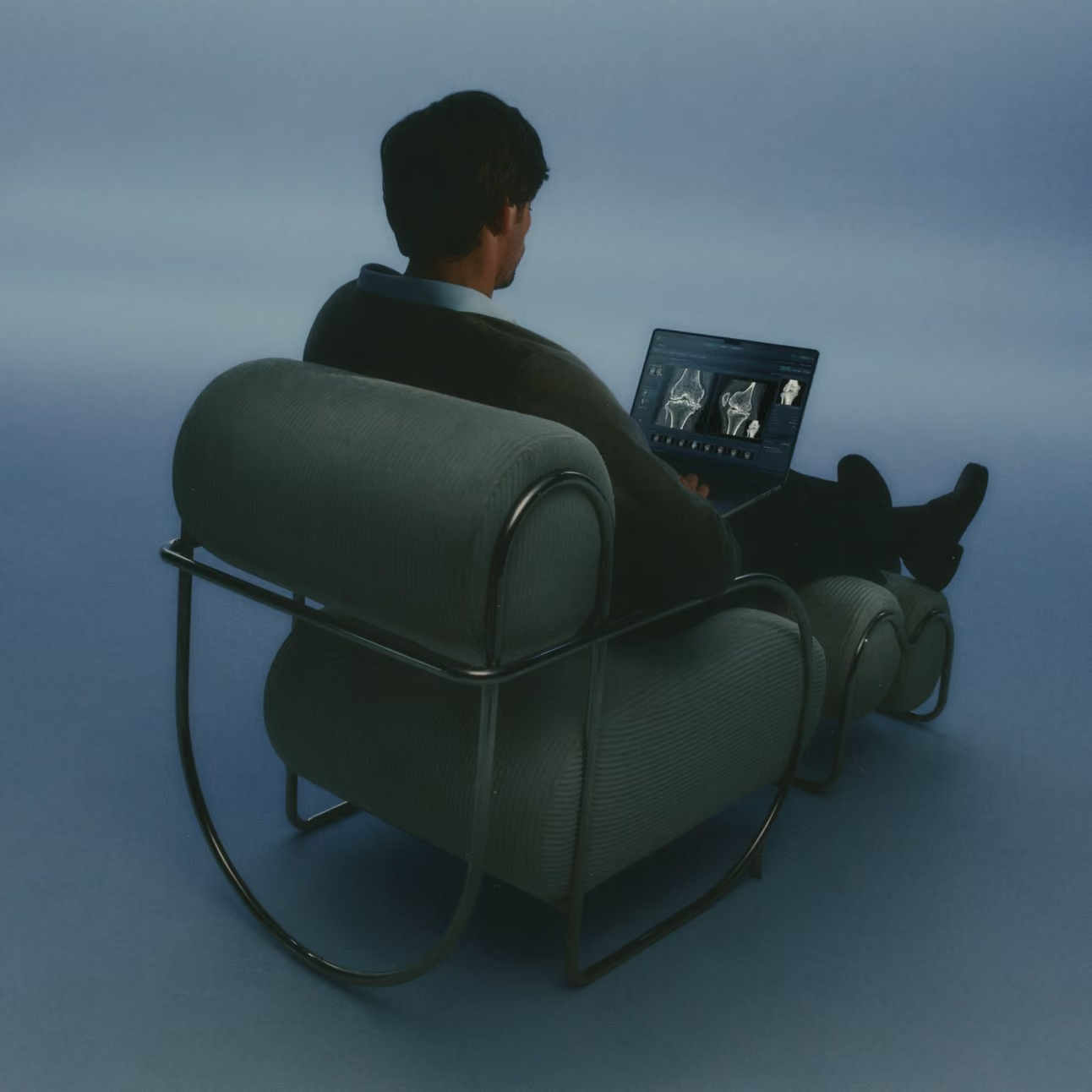
You set the course. The intelligent surgical system follows through.
Today
Robotic assistance improved precision
The gap
Robotic systems support surgeons throughout the procedure, but much of the physical and mental workload remains with the surgeon1-3,*
The opportunity
Translate the surgeon’s plan into autonomous execution of defined surgical tasks, with continuous monitoring and surgeon oversight

Every outcome can inform what comes next.
Today
Post-op monitoring is either extremely limited or difficult to find and analyze
The gap
Hard-to-find data, more to check
The opportunity
Autonomously analyze recovery data, identify patients deviating from expected progress and deliver actionable insights to the care team — while informing future surgical planning

By connecting surgical and recovery insights, future intelligent systems could help inform the next surgical plan — creating the potential for continuous improvement across the care journey.

Stay in the know

1.
Parsons H, Metcalfe A, Griffin J, et al. Robotic-arm-assisted versus conventional total knee replacement (RACER-Knee): a pragmatic, multicentre, participant-masked and assessor-masked, superiority, randomised controlled trial. Lancet. Published online August 20, 2026. doi:10.1016/S0140-6736(26)00986-4
2.
Sexton K, Johnson A, Gotsch A, Hussein AA, Cavuoto L, Guru KA. Anticipation, teamwork, and cognitive load: chasing efficiency during robot-assisted surgery. BMJ Qual Saf. 2018;27(2):148-154. doi:10.1136/bmjqs-2017-006701
3.
Vasireddi N, Vasireddi N, Shah AK, et al. High prevalence of work-related musculoskeletal disorders and limited evidence-based ergonomics in orthopaedic surgery: a systematic review. Clin. Orthop. Relat. Res. 2024;482:659-671. doi:10.1097/CORR.0000000000002904
4.
Como CJ, Flanagan M, Cong GT, et al. Electronic health record usage in an academic orthopaedic sports medicine practice. J. Orthop. Exp. Innov. 2023;4(2):1-9. doi.org/10.60118/001c.82078
5.
Ross PP, Okafor LC, Rumps MV, Mulcahey MK. Promoting wellness among orthopaedic surgeons. JBJS Open Access. 2025;10:e24.00090. doi:10.2106/JBJS.OA.24.00090
*
Reference #1 is a single randomized controlled trial of 339 patients treated by 33 surgeons. Reference #2 is a single study of 27 surgical team members (including 3 lead surgeons) across 12 robot-assisted surgeries. Reference #3 is a multi-study of 19 survey-based studies including 2,974 orthopedic surgeons. Reference #4 is a single study of 4 surgeons. Reference #5 is a narrative review citing a single AAOS survey of 6,775 respondents.
